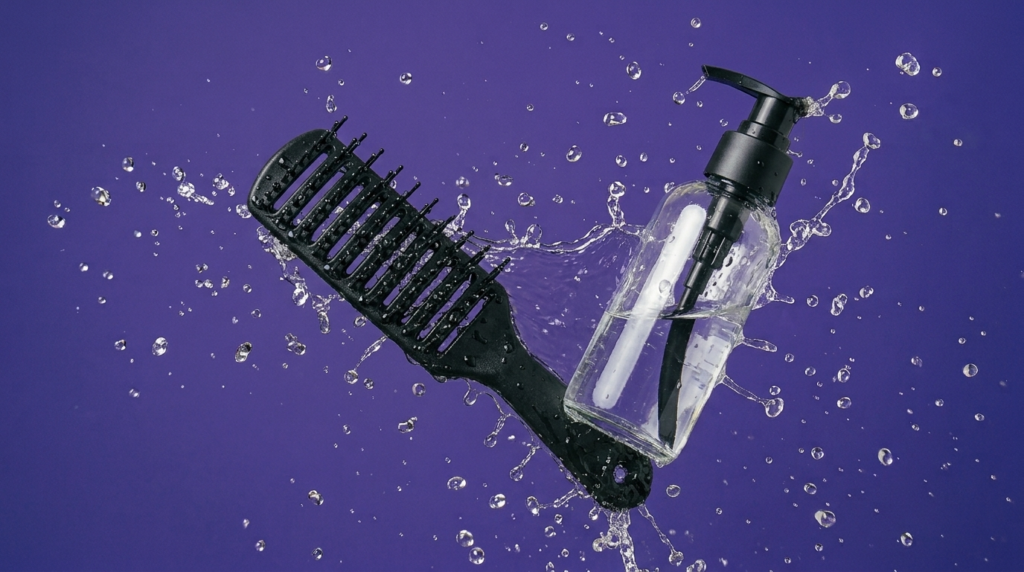
One of the most baffling experiences on wash day is stepping out of the shower, looking in the mirror, and seeing a layer of fuzzy frizz sitting on your soaking wet hair. The common rule of thumb in the hair community is that frizz only happens when your hair dries out. But if you have fine, high-density Asian curly hair, you know that your hair can look frizzy before you even touch a blow dryer.
This frustrating phenomenon is known as the “wet frizz” trap. No matter how much water you splash on your head or how carefully you squeeze it, those tiny, loose hairs refuse to join together into smooth, defined curls. Instead, they stand up in a chaotic web of damp static.
Fixing wet frizz doesn’t require piling on heavy products. The solution lies in changing how you introduce moisture and how you seal your fragile strands while they are still wet.
The Web of High-Density Water Retention
To understand why your hair frizzes while wet, you have to look at the unique relationship between water and high-density fine strands. Because your individual strands are so structurally thin, they have a very low capacity to hold onto moisture internally. However, because you have an immense number of these strands packed tightly together, your hair holds an enormous amount of external water trapped between the hairs.
When your hair stays soaking wet for long periods, the external water weight pulls your delicate strands downward, stretching them out. Because your cuticles are fine and easily raised, the individual strands begin to catch on one another like miniature hooks as they float in the water.
Instead of smoothly grouping together into clean, cohesive curl structures, your fine strands repel each other and break away from their clusters. The water is actually forcing your fragile strands apart, creating a layer of disorganized, frizzy hairs that harden into a fuzzy mess by the time your hair finally dries.

How to Defeat the Wet Frizz Trap
Your fine, dense coils need structural alignment while they are completely saturated with water. The goal is to force your fine strands to stick together into smooth groups before the air can disrupt them. Use these targeted styling adjustments to eliminate wet frizz:
- Style on Soaking, Dripping Wet Hair: Do not even touch a towel until your styling products are fully applied. Your fine strands need to be completely flooded with water so they can glide into their natural curl groupings smoothly without catching on each other.
- The “Squish to Condish” Method: When applying your lightweight conditioner or leave-in, cup water in your hands and scrunch it upward into your hair with a squishing sound. This forced pressure pushes the moisture into the fine cuticles rather than letting it sit heavily on the outside. When you cup the water and press it into your hair, you should hear a loud, soaking-wet ‘squelch’ or ‘squish’ sound. If it sounds faint or quiet, your hair isn’t wet enough—add another splash of water and squish again!
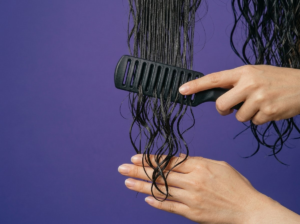
- Use a Defining Brush System: Because your hair is high-density, your fingers cannot evenly distribute product to every single strand. Use a flexible styling brush with widely spaced rows on soaking wet hair to mechanically comb your fine strands into organized, uniform clumps. Look for a Denman-style defining brush or a pliant wet-styling brush where you can manually slide out rows of bristles to create wider spaces. This specific tool acts like a miniature loom, smoothing your fine strands into perfect, uniform ribbons.
- Seal Immediately with a Flash-Drying Gel or Mousse: The moment your curls look smooth and wet, apply a lightweight holding product. This locks the smooth strands into place and prevents them from separating and expanding outward into a web of frizz as the drying process begins.
Common Mistakes That Trigger Wet Frizz
To keep your wet curl groupings completely smooth, eliminate these common styling habits:
- Drying Your Hair with a Traditional Towel First: Blotted or towel-dried hair instantly loses the moisture shield it needs to group together. Applying products to damp hair instead of soaking wet hair is the number one cause of chronic wet frizz.
- Raking Products Through Semi-Dry Hair: Never use open, dry fingers to rake styling creams through your hair once it has started to dry. Raking breaks apart the delicate, half-formed curl clusters, causing instant separation and fluffiness.
- Using Products with Heavy Proteins: While fine hair needs some protein for structural strength, using heavy protein treatments too frequently causes your cuticles to become stiff, brittle, and rough. Check your bottles and avoid products that list ingredients like hydrolyzed wheat protein, keratin, amino acids, or collagen in the top five ingredients. Overdoing these heavy proteins makes your wet strands completely reject water, triggering instant frizz.
Smooth from the Start
Frizz doesn’t start when your hair dries; it starts the moment your delicate strands lose their structure in the shower. By handling your hair while it is soaking wet, using a defining brush to organize your dense sections, and sealing the shape immediately, you can escape the wet frizz trap for good.
Have you noticed your hair fuzzing up while it’s still wet, or does your frizz only show up after it dries? Let me know in the comments below!
Ready to lock your wet curls into a smooth, long-lasting shape without any added weight? Check out our curated list of the 3 Best Curl-Defining Brushes for Fine, High-Density Asian Curls or the 3 Best Lightweight Styling Gels for Fine, Tight Asian Curls to find your perfect match!