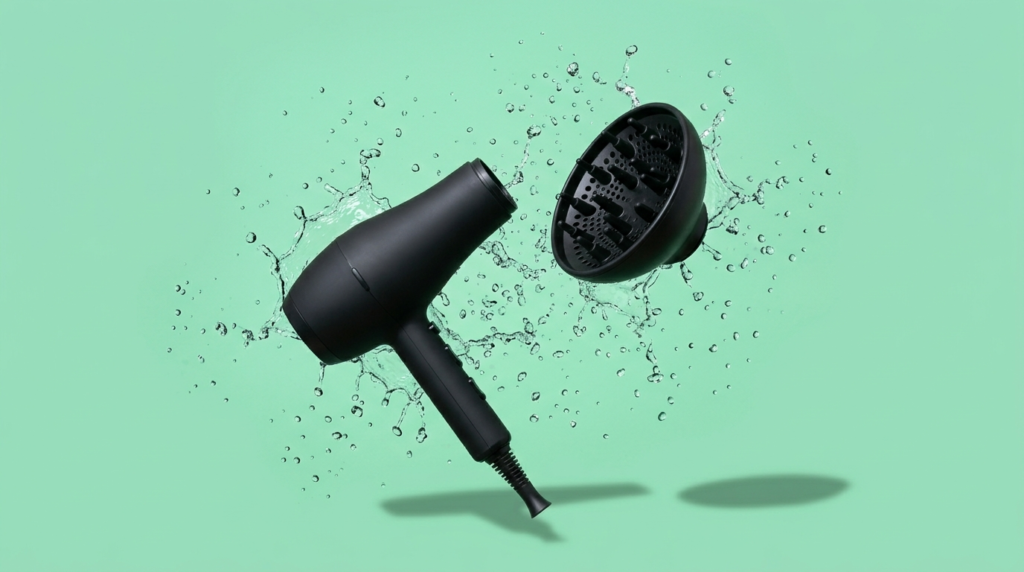
Drying fine, high-density Asian curly hair is a massive test of patience. Because you have an incredible number of strands packed tightly together, your hair acts like a thick sponge that holds onto moisture for hours. If you leave it to air dry, your roots can stay damp for half the day, allowing gravity to slowly drag your tight coils down until they stretch out and flatten.
However, picking up a traditional blow dryer usually backfires. The powerful rush of air violently separates your delicate, fine strands, blowing them completely out of their natural coil groupings. By the time your hair is dry, you are left with a massive, unstructured cloud of fluff instead of defined, bouncy curls.
The secret to drying dense, fragile hair quickly without triggering an explosion of frizz is all about managing airflow. By changing how you position your blow dryer, you can set your curl shape in minutes.
The Frizz Physics of Fine, High-Density Hair
To understand why traditional drying destroys your curl definition, you have to look at how styling products interact with your fine strands. When you apply a lightweight gel or mousse to soaking wet hair, it wraps around your fine strands and creates a protective coating called a “cast.” As this cast dries, it locks your tight coils together into neat, defined groupings, known as clumps.
On fine hair, this protective styling cast is incredibly delicate. If your blow dryer’s air stream hits your wet curls directly, it shatters the wet cast before it can harden.
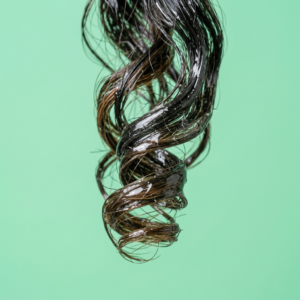
Because you have high-density hair, those thousands of loose, fine strands instantly expand outward to find room, rubbing against one another and generating static electricity. This friction breaks apart your natural coil groupings, leading to instant, stubborn frizz that no cream or serum can fix after the fact.
How to Master the “Hover Diffuse” Technique
Your fine, high-density hair needs the speed of heat drying, but it cannot handle the physical disturbance of strong wind. The hover diffuse method provides gentle, indirect heat that hardens your styling product’s cast safely before any air can ruffle your strands. Use these exact steps to set your curls:
- Dial In Your Settings: Attach a large bowl diffuser to your hair dryer. Flip the settings to medium heat and low airflow. High airflow will instantly ruin the technique, so keeping the wind speed low is absolutely critical.
- Hover Two Inches Away: Tilt your head to the side and hold the diffuser bowl two inches away from your hair. Slowly move the dryer around your head in a continuous circular motion, hovering near the roots and mid-lengths. Keeping it moving prevents the medium heat from burning your scalp.
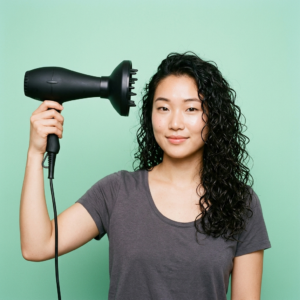
- Listen to the “Cast” (Not the Clock): Resist the urge to push the bowl into your hair or scrunch with your hands while it is wet. Hover until you can gently tap a curl and feel a firm, hard, paper-like shell form over the strands. If it still feels soft, sticky, or damp, keep hovering.
- Scoop Only at the Very End: Once that protective outer shell is formed and your hair feels about 80% dry, you can safely use the diffuser bowl to scoop your curls upward toward your scalp. Hold still for 20 seconds per section to safely boost your root volume.
- Break the Crunch: Turn off your dryer once your hair is 100% dry. Your curls will feel stiff and hard; this is normal! Rub a tiny bit of product (see below ⚠️) between your palms, and gently clap and scrunch your hair. The hard shell will instantly melt away, revealing touchably soft, bouncy corkscrews.
⚠️ The Fine Asian Hair Exception: Read This Before Grabbing an Oil!
Because Asian hair cuticles are naturally smooth and your strands are fine, heavy oils are your absolute enemy. Avoid thick oils like coconut, castor, or heavy silicone serums—they will instantly weigh your tight coils down, making them look greasy and flat.
Instead, you have two microscope-safe options to break your cast:
- The Zero-Product Method: You don’t actually need oil! If your hair gets weighed down easily, use completely bare, dry hands or wrap a satin scarf around your hands to scrunch out the crunch. It removes the stiffness with zero added weight.
- The Featherweight Oils Only: If your hair feels a bit parched, use only 1 to 2 drops of a featherweight, high-penetration oil like Jojoba oil, Argan oil, or Squalane. Rub it into your palms until your hands just look shiny, then gently clap the hair.
Common Drying Mistakes to Avoid
To maintain crisp, tight curl definition, eliminate these common blow-drying habits:
- Using High Wind Speeds: High speed turns a diffuser into a wind tunnel. Fine strands lack the structural weight to resist heavy wind and will instantly separate into a frizzy halo.
- Flipping Your Head Constantly: Constantly whipping your hair back and forth while drying causes your dense strands to violently tangle against each other, breaking up your natural coil pattern.
- Diffusing Without a Cast Product: Never blow-dry fine, dense hair with just a leave-in conditioner. Without a lightweight holding gel or mousse to anchor the fine strands together, the heat will dry out your hair and cause immediate fluffiness.
Set the Shape, Keep the Bounce
Your fine, tight coils do not have to be a frizzy mess just because you want a fast drying time. By utilizing indirect, hovering heat, you can lock in your styling product’s protective cast, preserve your tight coil groupings, and drastically cut down your wash-day routine.
Have you ever tried hovering your diffuser, or do you usually push the bowl straight into your curls? Let me know in the comments below!
Looking for the right tools to create the perfect, crunch-free cast for your next diffuse session? Check out our curated list of the 3 Best Low-Airflow Hair Dryers for Fine, High-Density Asian Curls or the 3 Best Weightless Mousses for Fine, Tight Asian Curls to complete your routine!